
NORTHEASTERLY: Prosperity and Opportunity in New England Northern Border States
Welcome to Northeasterly!
By Jacob Sesker
Our goal in launching Northeasterly is to provide a resource to economic developers, planners, leaders, legislators, lenders, and funders seeking a deeper understanding of economic trends and solutions in Northern New England. If you think that we are missing an important story about the economies of Maine, New Hampshire, or Vermont, please don’t hesitate to reach out!
Content for Northeasterly is developed by Harpswell Strategies, LLC, a Maine-based economic development and public policy consultancy. This content is researched and written by @Jacob Sesker (Principal), as well as two talented young analysts: @Addison Davis and @Oscar Herrera. To contact Northeasterly, e-mail jacob@harpswellstrategies.com and reference Northeasterly in the subject line.
Our Approach
Each month we will provide an overview of one industry or topic that is important to the economic development of the region. In one or more subsequent posts, we’ll dive in – spotlighting what is happening in that industry in Northern New England, providing relevant case studies, and exploring some best practices in economic development that relate to the industry.
Healthcare by the Numbers
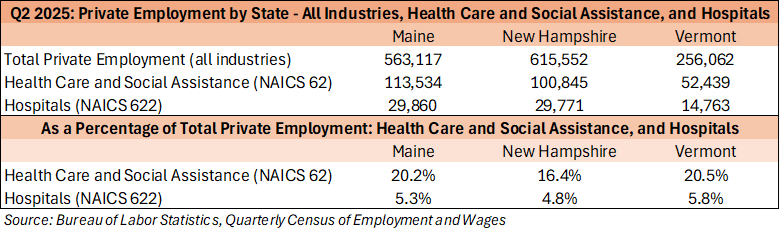
It is frequently stated that healthcare is one-sixth of the national economy. If anything, that undersells the significance of healthcare in the nation’s oldest region – healthcare represents more than one-fifth of private employment in both Maine and Vermont. Hospitals alone represent approximately one-twentieth of the region’s economy.

Commercial Real Estate & Healthcare
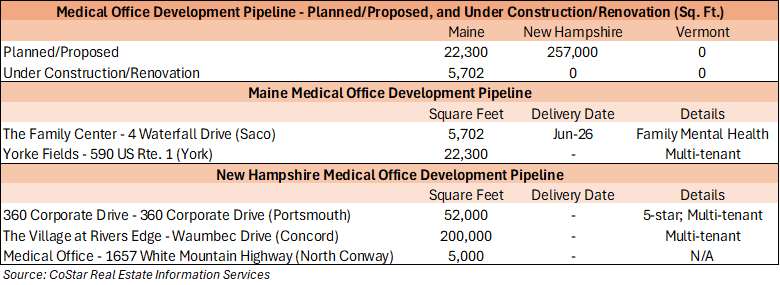
Healthcare generally occurs “in-person.” As such, as demand for healthcare increases, it is often accompanied by development of new medical offices. This distinguishes healthcare from many of the other industries that typically occupy commercial real estate (for example, firms in professional and business services often rely on remote workforces and are contributing less to new commercial real estate development than was the case several years ago).
Constrained Supply of Practitioners, Nurses, and Technicians
Nationally, rural communities find it increasingly difficult to attract and retain talent for key positions. A healthcare provider’s ability to deliver quality care is inextricably linked to the availability of trained healthcare professionals, including physicians, nurses and technicians. Providers often struggle to maintain high standards without sufficient staff, leading to longer waits, rushed consultations and a higher risk of errors.
Specialists perform procedures that can be a significant source of revenue. As such, the problems attracting or retaining specialists can create cascading problems for the bottom line of rural hospitals.
General practitioners, such as doctors of internal medicine, can earn significantly more in urban markets than they can in rural markets. Communities that are not adequately served by general practitioners can experience declining health outcomes, higher absenteeism, and other associated health and economic problems.
Even when the healthcare practitioners are in place to provide the care that a community needs, the volume of patients that can be seen depends on the availability of nurses. Nursing positions have also been difficult to fill across the region, as many nurses left the profession due to retirement or pandemic-era burnout, and many qualified and experienced nurses have found that they can earn significantly more by working as traveling nurses rather than as employees of a particular provider or system.
Demand Factors
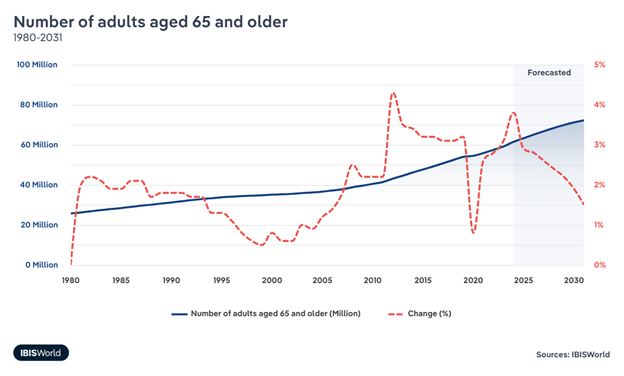
The number of individuals aged 65+ is a significant factor that drives demand for healthcare. While the size of that subpopulation will continue to grow, the rate of growth of the senior population is unlikely to reach current heights ever again.
The number of people with private health insurance is one factor that contributes to demand for healthcare. The aging population and current immigration policies are likely to contribute to very low population growth. It remains unclear whether the GOP can develop a healthcare plan that will lead to more individuals and households being covered by private health insurance.
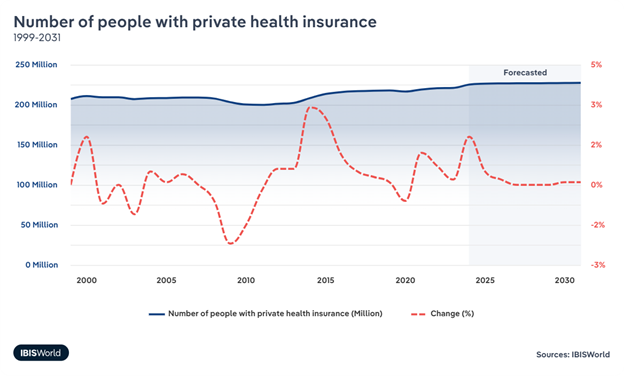
Other demand factors include federal funding for Medicare and Medicaid, total health expenditure, and per capita disposable income.
Some Light Reading
With respect to federal funding, this recent explainer by the Government Accountability Office is a good place to start; similarly, this 2025 Congressional Research Service report provides an excellent overview. Pew Research is the source covering the impact of Medicaid on state budgets. The National Rural Health Association provides resources, research, and advocacy related to rural healthcare.
Regional Economic Data Updates
The Federal Reserve Bank of Boston provides data dashboards for each state in the region: